Initial Summary
Fear of English is one of the most common reasons permanent residents postpone or abandon the idea of becoming citizens. However, the law provides important exceptions. In this article we explain the 50/20 and 55/15 rules, the N-648 medical exemption, and how to determine if you could qualify to take the citizenship exam in Spanish.
"I would like to become a citizen, but I don't speak English". This phrase is repeated in thousands of Hispanic households across the United States, and it is perhaps the most mentioned obstacle when discussing naturalization.
What many people do not know is that the English language is not always an absolute requirement. There are exemptions established by law that allow certain permanent residents to take the citizenship exam in their own language, including Spanish.
These exemptions are based on age, time as a permanent resident, and in some cases, documented medical conditions. Understanding them could be the first step toward no longer postponing a process that could change your life.
What Is Form N-400 and What Role Does Language Play?
English is part of the process, but it is not always an insurmountable requirement.
Form N-400 is the official application for naturalization as a U.S. citizen. One of the key components of the process is the interview with a USCIS officer, where two things are typically evaluated:
- Ability to read, write, and speak basic English.
- Knowledge of U.S. history and government (civics exam).
For most applicants, both tests are conducted in English. However, federal law recognizes that for certain individuals, especially older adults with many years of residency, requiring English proficiency could be unfair or disproportionate.
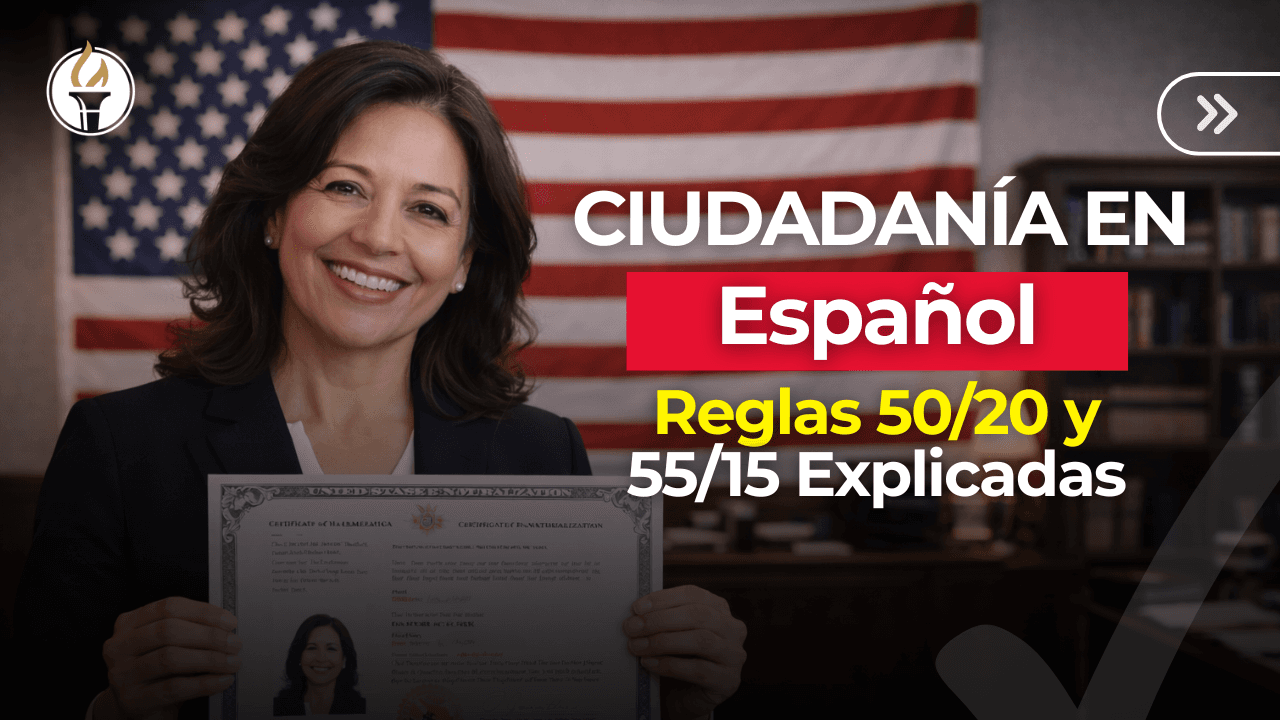
The 50/20 Rule: Exam in Spanish If You Are 50+ with 20+ Years as a Resident
If you are 50 or older and have been a permanent resident for at least 20 years, you could qualify.
This is one of the most well-known exemptions. Under the 50/20 rule, a permanent resident could take the citizenship exam in Spanish (or their native language) if they meet <strong>both requirements</strong>:
- Be at least 50 years old at the time of filing the N-400 application.
- Have been a legal permanent resident (green card holder) for at least 20 years.
The 55/15 Rule: Another Option for Older Residents
If you are 55 or older and have been a resident for 15 years, you could also qualify.
The 55/15 rule works similarly to the 50/20, but with different thresholds. A permanent resident could qualify if they meet:
- Be at least 55 years old at the time of filing the application.
- Have been a legal permanent resident for at least 15 years.
The benefits are the same as under the 50/20 rule:
- Civics exam in Spanish (or native language).
- No English reading, writing, or speaking test.
- Right to bring an interpreter to the interview.
- Civics exam questions drawn from the designated group of 20.
What If You Don't Meet the 50/20 or 55/15 Rule?
There could be another option
Not all older permanent residents meet the combined age and time requirements. For example, someone who is 52 years old with only 12 years of residency would not qualify under either rule.
However, there is a third possibility that many people are unaware of: the medical exemption through Form N-648. This exemption does not depend on age or time as a resident, but rather on a documented medical condition that prevents learning English or understanding civics material.
The N-648 Medical Exemption: When a Condition Prevents Learning English
The N-648 recognizes that certain medical conditions can make it impossible to learn a new language.
Form N-648 is a medical certification that an authorized doctor completes to request that the applicant be exempt from the English requirements and/or the civics exam. Conditions that could qualify include:
- Cognitive decline or age-related memory loss.
- Diagnosed intellectual or developmental disabilities.
- Severe post-traumatic stress disorder (PTSD).
- Effects of strokes or traumatic brain injuries.
- Documented learning conditions that prevent acquiring a new language.
- Neurodegenerative diseases such as Alzheimer's or dementia.
The Doctor's Role in the N-648
The medical form is the centerpiece
The success of the N-648 exemption depends largely on the quality of the medical certificate. The doctor who completes the form must:
- Be a licensed physician, osteopath, or clinical psychologist.
- Describe the patient's medical condition in detail.
- Specifically explain how the condition prevents learning English or understanding civics material.
- Indicate whether the condition is permanent or long-lasting.
- Base the certification on a direct examination of the patient, not solely on third-party reports.
USCIS reviews these certifications very carefully. A poorly completed, vague N-648 form that does not clearly establish a connection between the condition and the inability to learn could be denied.
Hypothetical Examples
Imagine Maria, a 58-year-old permanent resident who obtained her green card 16 years ago. She never learned English because she worked for decades in environments where only Spanish was spoken. Under the 55/15 rule, Maria could qualify to take the civics exam in Spanish and bring an interpreter to her citizenship interview.
Now imagine Roberto, age 45, with only 8 years as a permanent resident. He does not qualify under the 50/20 or 55/15 rules. However, Roberto suffered an accident years ago that left him with severe memory and concentration problems. His doctor could complete an N-648 form certifying that his condition prevents him from effectively learning English, which could exempt him from those requirements.
Important Clarifications: What Exemptions Do Not Eliminate
Language exemptions are not a free pass
It is essential to understand that qualifying for a language exemption does not mean citizenship is guaranteed. Even with the exemption, the applicant must meet all other naturalization requirements:
- Demonstrate good moral character during the required period.
- Have maintained continuous residence and physical presence in the United States.
- Have no pending legal issues that could affect eligibility.
- Correctly complete Form N-400 and submit all documentation.
- Attend the interview and truthfully answer all questions from the officer.
Additionally, each case is evaluated individually. USCIS has the authority to verify the authenticity of the N-648 medical certification and could request additional evaluations if it has concerns.
Conclusion
The English language does not always have to be a definitive obstacle to citizenship. The 50/20 and 55/15 rules exist precisely to recognize that many permanent residents have contributed to this country for decades without necessarily mastering English. And the N-648 medical exemption offers an alternative for those facing conditions that prevent them from learning.
If you or a family member has postponed citizenship out of fear of the English exam, learning about these options could be the first step. An immigration attorney could help you evaluate which exemption applies to your situation and prepare your case in the strongest way possible.
Consult with an Attorney NowSources Cited
- USCIS – Exceptions and Accommodations for the English and Civics Tests
- USCIS – Form N-648, Medical Certification for Disability Exceptions
- INA § 312(b)(2) – Language Exemptions for Naturalization
- USCIS Policy Manual, Vol. 12, Part E – English and Civics Testing